

Chile has long been recognised as one of Latin America’s most ambitious climate leaders. Its climate strategy goes beyond setting targets on paper. The country is building the legal, institutional, financial, and digital infrastructure needed to turn climate commitments into measurable action.
At the centre of this transition is Chile’s move towards a modern National Carbon Registry, a digital platform designed to support carbon market transparency, climate finance, domestic carbon pricing instruments, and international cooperation under Article 6 of the Paris Agreement. Xeptagon is proud to be contracted as the developer of this important initiative, contributing its experience in national carbon registries, Article 6 infrastructure, MRV systems, transparency platforms, and multi-asset environmental market technology.
A national carbon registry is a core component of climate market infrastructure. It determines how mitigation activities are recorded, how carbon certificates are issued, how ownership is tracked, how transfers are managed, how retirements are verified, and how a country demonstrates environmental integrity to domestic and international stakeholders.
For Chile, the registry is an essential building block in a much larger climate transition.
Chile’s Climate Ambition and the Role of Market Infrastructure
Chile has positioned itself as one of Latin America’s leading countries in climate action, with a legal commitment to achieve carbon neutrality by 2050 under its Climate Change Framework Law. This law establishes the foundation for long-term climate governance, covering mitigation, adaptation, reporting, sectoral planning, and carbon market mechanisms, while aligning domestic climate action with Chile’s commitments under the Paris Agreement.
As Chile moves from policy design to implementation, digital infrastructure becomes essential. High-integrity carbon markets cannot operate effectively through fragmented systems, manual processes, or disconnected registries. In this context, the National Carbon Registry is a strategic component of Chile’s climate architecture, providing the digital backbone to record mitigation activities, track certificates, support transfers and retirements, and connect domestic carbon market mechanisms with international systems.
The registry initiative is being developed within the context of the World Bank’s Partnership for Market Implementation (PMI), which supports countries in designing and implementing carbon pricing instruments aligned with national priorities. This gives the project significance beyond administrative record keeping. It forms part of Chile’s broader effort to build market infrastructure for carbon pricing, Article 6 cooperation, climate finance mobilisation, and the next generation of interoperable carbon markets.
Chile’s Carbon Market Framework: Domestic and International Pathways
Chile’s carbon market framework brings together two important policy tracks.
The first is the domestic track under Article 15 of the Climate Change Framework Law. This enables the use of certificates that accredit greenhouse gas emission reductions or removals from projects implemented in Chile. These certificates can support compliance with emission standards, subject to requirements such as additionality, measurability, verification, permanence, environmental and social benefits, and consistency with Chile’s Nationally Determined Contribution. The law also requires a public registry containing approved projects and verified certificates, with unique electronic identifiers, transferability, and cancellation once used.
The second is the international track under Decreto 32, which regulates the conditions and requirements for certificates of reduction or absorption of greenhouse gas emissions in the context of Article 6 of the Paris Agreement. This framework covers activity authorisation, ITMO generation, corresponding adjustments, participant authorisation, certification programme recognition, methodology validation, monitoring, verification, transfer, use, cancellation, and reporting.
Together, these frameworks require a registry that can support both domestic compliance and international cooperation. The platform must be able to distinguish between certificates used within Chile and internationally transferred mitigation outcomes used under Article 6. It must prevent double counting, preserve the integrity of ownership history, and ensure that all certificate lifecycle events are auditable.
A modern registry also allows Chile to prepare for future market evolution. Carbon markets are becoming more connected, more regulated, and more data-driven. Registries increasingly need to interoperate with systems such as CAD Trust, voluntary carbon standards, national reporting platforms, and transparency systems. Xeptagon’s Article 6 systems are designed for interoperability with CAD Trust, UNFCCC-aligned processes, voluntary standards such as Verra and Gold Standard, and national regulatory bodies.
Xeptagon’s Role in the Chile National Carbon Registry
Xeptagon’s work on the Chile National Carbon Registry focuses on supporting the design and development of a national platform based on the Digital Public Good Carbon Registry initiated by UNDP, connected to CAD Trust, and aligned with UNFCCC Article 6 reporting through the Agreed Electronic Format. The registry will support the full lifecycle of mitigation activities, from project application and authorisation through MRV, certificate issuance, transfer, and retirement.
The work includes aligning Chile’s registry design with domestic requirements under Article 15 and international requirements under Decreto 32 and Article 6. This means developing a system capable of handling multiple workflows, multiple asset types, multiple actors, and multiple regulatory outcomes within one coherent platform.
A key design principle is the “single window” approach. Rather than creating separate systems for each climate instrument, the registry can operate as a unified digital platform with instrument-specific pathways. In this model, the same infrastructure can support domestic certificates, Article 6 ITMOs, public registry functions, MRV workflows, and future extensions.
For regulators, this reduces fragmentation. For project participants, it simplifies engagement. For the market, it strengthens trust.
Built on Proven Experience: UNDP, Article 6, Article 13, and National Registries
Xeptagon brings direct experience in developing climate and carbon market systems for governments, multilateral organisations, and regulated entities.
Xeptagon designed, developed, and maintains the UNDP National Carbon Registry, which supports national carbon credit issuance, tracking, and Article 6-ready operations across multiple countries. Xeptagon’s own Article 6 infrastructure is built on the same architecture developed for UNDP and deployed across national programmes.
This experience is important because national carbon registries must be both technically robust and policy-aware. They must translate complex legal requirements into usable workflows, ensure that data structures match reporting obligations, and preserve auditability across the entire lifecycle of a carbon asset.
Xeptagon’s work also extends beyond Article 6. Under Article 13 of the Paris Agreement, countries are required to report climate action and progress through the Enhanced Transparency Framework, including Biennial Transparency Reports. Xeptagon has developed the UNDP Digital Transparency System to support national transparency reporting, MRV workflows, greenhouse gas inventory components, and BTR preparation processes.
This creates a powerful connection between carbon market infrastructure and climate transparency infrastructure. Article 6 markets cannot be separated from Article 13 reporting. A country must not only issue and transfer mitigation outcomes; it must also report them accurately and show how they are reflected in national climate accounting.
Xeptagon’s work also includes climate finance and results-based finance infrastructure. One example is its work supporting the Central African Forest Initiative (CAFI), where Xeptagon designed and developed a Payment for Environmental Services (PES) and forest finance platform to support digital MRV and results-based finance. CAFI is a major forest finance initiative focused on forest protection, climate finance, and sustainable land-use outcomes.
This experience is relevant to Chile because the future of carbon markets is not only about trading credits. It is about linking climate outcomes to finance. Countries need systems that can connect projects, monitoring data, verification results, payments, certificates, claims, and public reporting. A registry can become a bridge between climate policy and climate finance.
For Chile, this is especially relevant as the country develops its climate finance ecosystem, strengthens carbon pricing instruments, and prepares for deeper participation in international markets.
Key Platform Capabilities of Xeptagon’s Carbon Registry
The National Carbon Registry developed by Xeptagon is based on its latest Multi-Asset Environmental Asset Platform, combining registry, MRV, Article 6, interoperability, and market infrastructure capabilities within a flexible architecture.
Key capabilities include:
- +
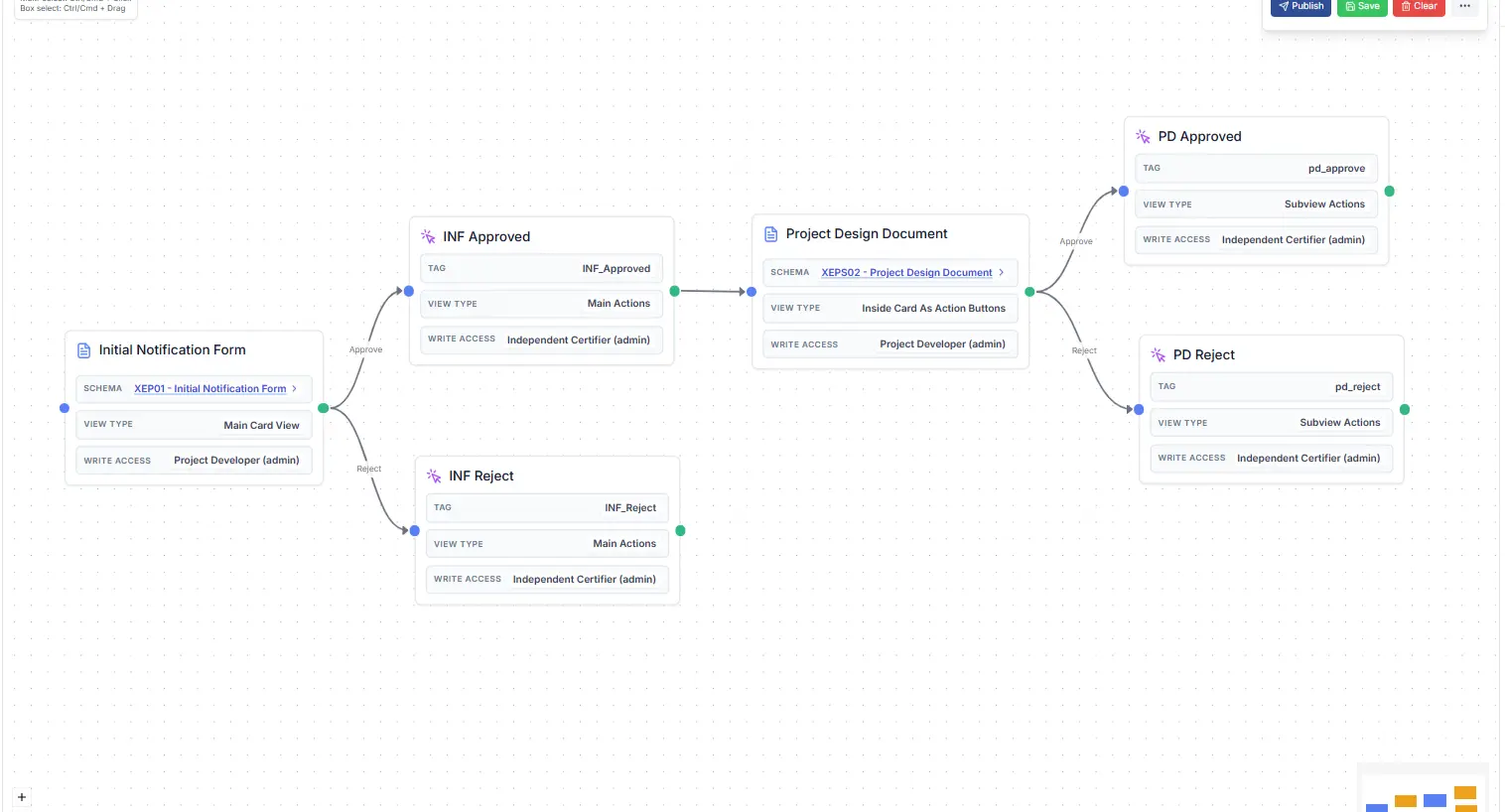
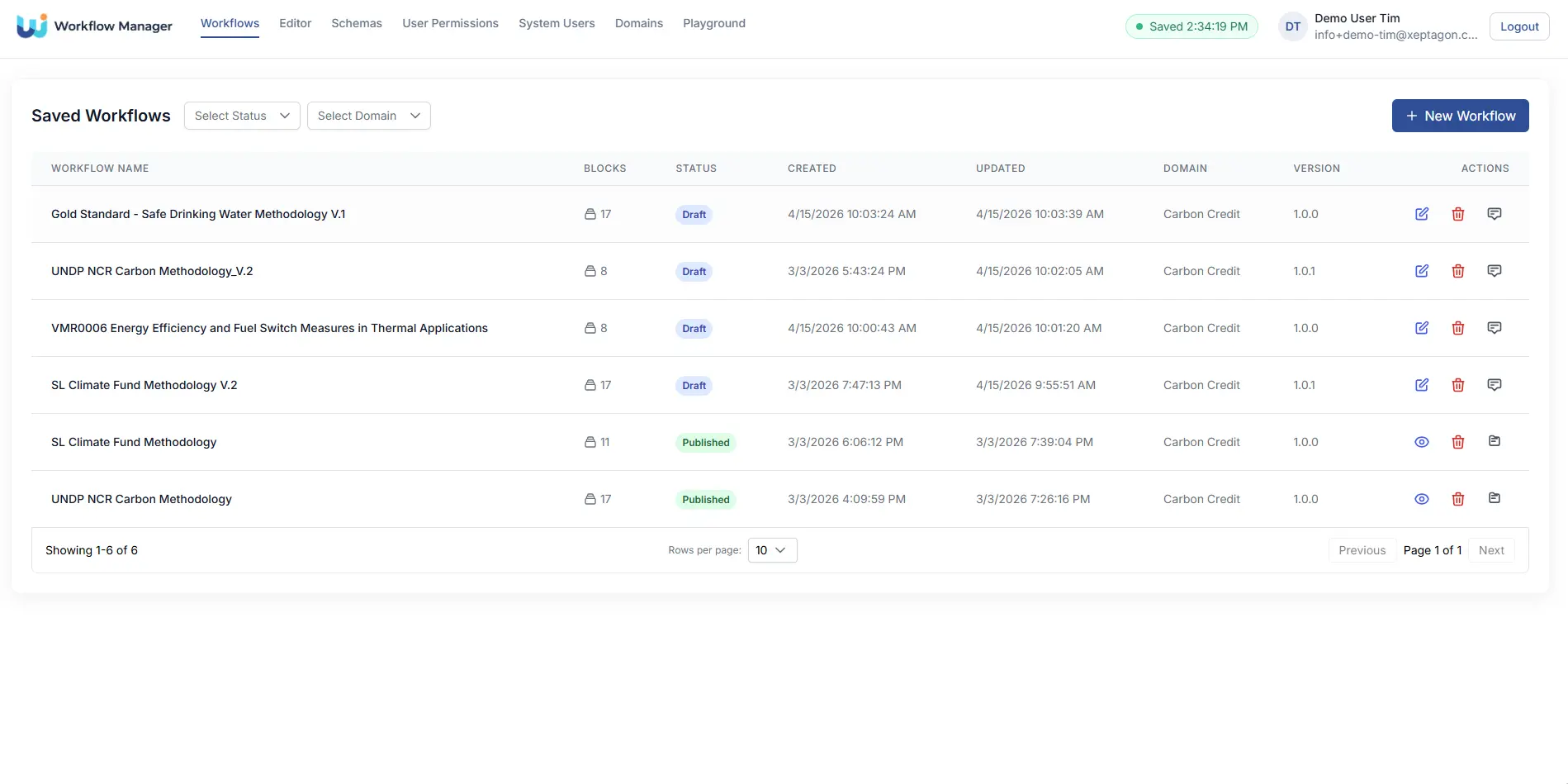
Configurable programme workflows and approval processes
The platform supports different programme rules, approval steps, document requirements, and review processes depending on the applicable carbon market instrument or regulatory pathway. - +
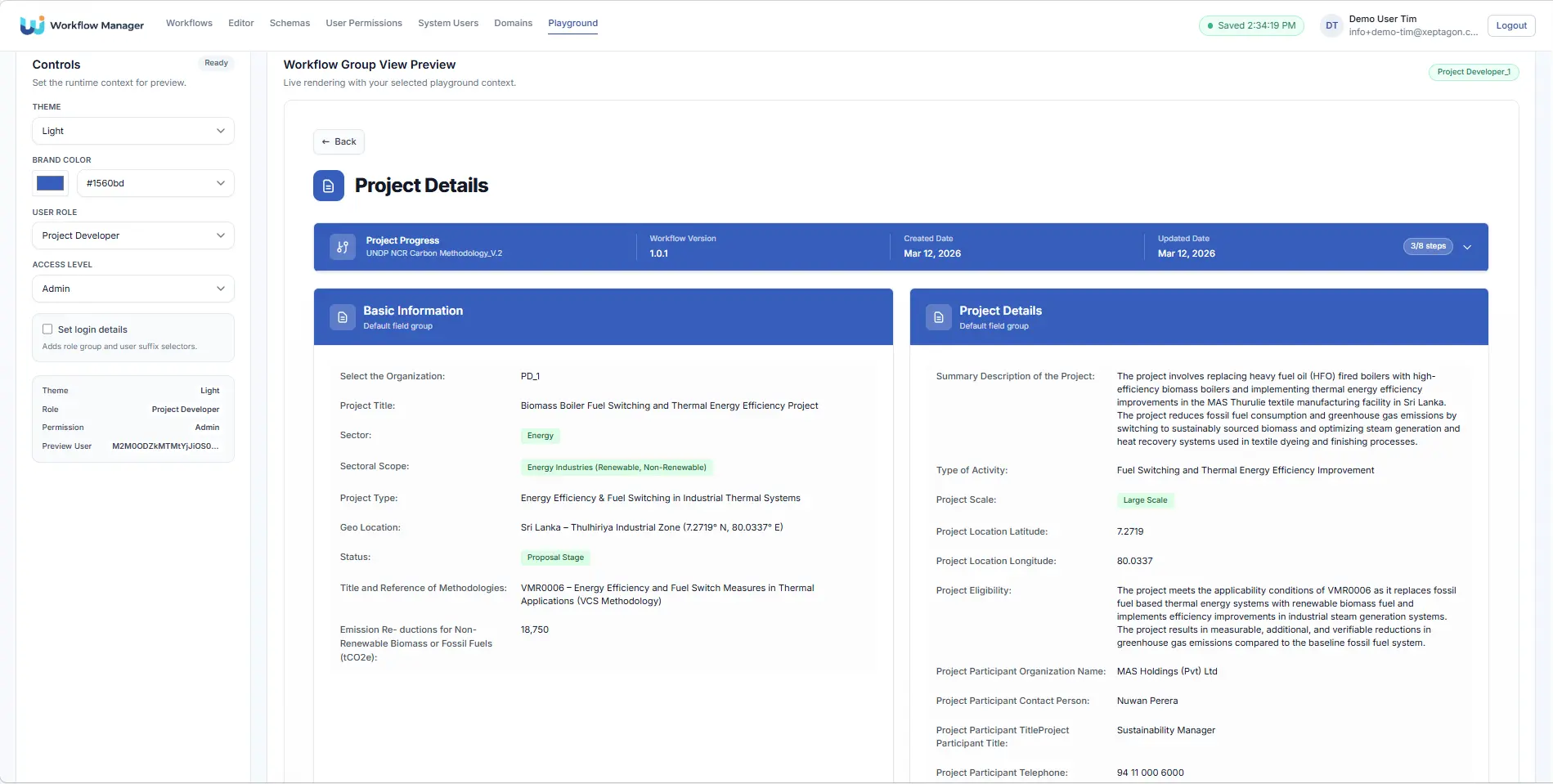
Dynamic user, role, and permission management
Government administrators can define user roles, access levels, reviewer responsibilities, and approval permissions across agencies, verifiers, project participants, and market actors. - +
Project lifecycle and activity tracking
The system tracks mitigation activities from initial submission through validation, approval, monitoring, issuance, transfer, retirement, and cancellation, ensuring that every stage is recorded and auditable. - +
Full audit trails and transaction traceability
Every system action, certificate movement, ownership change, and status update can be captured through a complete audit trail, supporting transparency and regulatory confidence. - +
Advanced reporting, analytics, and dashboards
The platform provides real-time insights into project pipelines, issued units, transfers, retirements, and market activity for regulators, administrators, and authorised stakeholders. - +
Article 6-ready architecture and market interoperability
The registry supports ITMO authorisation, first transfer tracking, corresponding adjustment support, and alignment with international reporting processes. - +
Registry interoperability and API-based connectivity
The system connects with external registries, MRV systems, transparency platforms, exchanges, and international data layers through secure APIs and structured data exchange. - +
Support for future environmental assets
Beyond carbon credits, the same registry foundation can be extended to emissions allowances, Sustainable Aviation Fuel (SAF) book-and-claim units, renewable energy certificates, guarantees of origin, biodiversity or nature-related credits, and other regulated or voluntary market instruments. - +
Blockchain-enabled trust and traceability layers
Blockchain components can strengthen transparency, asset provenance, tamper resistance, and public trust while preserving government control over the registry and its governance processes. Xeptagon works closely with Hedera to support blockchain-enabled registry capabilities, including integration with Hedera Guardian and digitised methodologies maintained within the Hedera ecosystem. This allows registry operators to enhance verification, traceability, and auditability while keeping regulatory authority, data governance, and operational control within the government-led registry framework. - +
CAD Trust compatibility and Article 6 reporting support
The platform can support CAD Trust compatibility and UNFCCC Article 6 Electronic Format and Agreed Electronic Format reporting requirements. - +
Article 6 authorisation, tracking, and reporting workflows
The system can manage activity authorisation, ITMO tracking, transfer status, use cases, cancellation, and reporting outputs. - +
Market connectivity
The registry can support controlled connectivity with exchanges, marketplaces, authorised trading platforms, voluntary carbon market infrastructure, and compliance market systems.
The platform is designed with flexibility in mind. Governments can adapt processes, forms, approval workflows, registry rules, and regulatory requirements without extensive software redevelopment. The same foundation can also support other environmental asset types beyond carbon credits, including emissions allowances, Sustainable Aviation Fuel book-and-claim instruments, renewable energy certificates, guarantees of origin, and other emerging climate and sustainability instruments over time.
Beyond Carbon: A Foundation for Environmental Market Infrastructure
While the immediate focus is the National Carbon Registry, the same architecture can support a much broader environmental market ecosystem. Climate policy is increasingly moving towards integrated market infrastructure, where carbon credits, emissions allowances, renewable energy instruments, sustainable aviation fuel (SAF) claims, guarantees of origin, and other environmental attributes need to be tracked with the same level of transparency and integrity.
For governments, this reduces duplication and improves institutional control. For market participants, it creates a clearer pathway to engage with different environmental instruments. For the broader climate finance ecosystem, it creates the data infrastructure needed to connect verified outcomes with investment, compliance, and market activity. Learn more about the Multi-Asset Environmental Market Registry here.
ETS Readiness and Emissions Registry Potential
The registry can also serve as a foundation for future emissions trading system readiness. As countries strengthen carbon pricing instruments, digital infrastructure must support not only project-based credits, but also emissions data, allowance allocation, compliance obligations, market transactions, and surrender or cancellation processes.
Xeptagon’s ETS-ready platform capabilities can support allowance issuance, allocation management, transfer tracking, compliance reporting, and regulator-facing market operations. These capabilities can be connected with the carbon registry foundation to create an integrated view of mitigation outcomes, regulated emissions, and market-based compliance instruments. Combined with MRV systems and transparency reporting, this creates a more complete digital infrastructure layer for national climate governance.
Xeptagon’s Commitment
Xeptagon is proud to support the development of Chile’s National Carbon Registry and to contribute its experience from UNDP carbon registry systems, Article 6 platforms, Article 13 transparency systems, CAFI climate finance infrastructure, ETS-ready platforms, and multi-asset environmental registry technology.
Our mission is to help governments and institutions build trusted systems that make climate action measurable, transparent, and financeable. Carbon markets can only scale with integrity if the infrastructure underneath them is secure, interoperable, and designed for long-term governance.
Chile’s National Carbon Registry represents exactly that kind of infrastructure. It is a foundation for transparent domestic carbon markets. It is a gateway to Article 6 cooperation. It is a platform for future environmental assets. And it is a key step in turning Chile’s climate ambition into operational reality.
For more information about Xeptagon’s climate and carbon market solutions, please contact us here. Learn more about our work in carbon markets, climate finance, and digital climate infrastructure supporting Fortune 500 companies, intergovernmental organisations, and governments worldwide here. Information on our Article 6-related services, platforms, and implementation experience can be found here.